
What is a Documentary?
A Documentary is a film or television programme that provides a factual report on a particular subject. There are several types of Factual Programming and each are designed to display information in a different way. I believe documentaries to be a wonderful piece of media that can display reality to those who might not realise what is really going on in different situations.
Expository Documentary
Expository documentaries speak directly to the viewer, mostly in the form of an authoritative commentary, proposing a strong argument and point of view. These films are rhetorical, and try to persuade the viewer. (They may use a rich and sonorous male voice.) The (voice-of-God) commentary often sounds ‘objective’ and omniscient. Images are often not necessary; they exist to advance the argument.

David Attenborough is a perfect example of a rhetorician who mainly appears in Expository Documentaries in which his lovely voice takes us to places that we wouldn't normally visit.
From my own example, I have found that We are the Lambeth Boys(Karel Reisz, 1957) Is also an Expository documentary.
Observational Documentary
Observational Documentaries are attempting to display lived life with minimal interference. It is the complete opposite of an Expository Documentary as Observational is spontaneous filming and a very light crew to follow the Rhetorician.

Armadillo (2010) Is a documentary that follows the story of some young Danish soldiers and their platoon deployed on a tour of Afghanistan. It shows the events as they are without any influence from the camera crew.
 An interactive documentary must contain several key features; The filmmaker is a participant and they're presence is evident; There is an interaction between interviewees; arguments are usually presented and manipulation of the text through editing is more evident.
 Louis Theroux: A Place for Paedophiles (2009), is the perfect definition of Interactive Documentary; It shows how life as an offender is and what the process is to get them back into society whilst questioning ethics and pushing the moral boundaries.
Michael Moore is another good example or someone who mainly produces Interactive Documentaries. He manipulates the footage to give a false sense of reality.
All moving image productions require releases and permissions, interactive documentaries are no exception to the rule. If a release for is not signed by the interviewee then it could have serious affect on the documentary, such as not being able to show whole arguments or discussions and the flow of the programme will not be as smooth as it otherwise could have been.
Reflexive Documentary

Performative Documentary
Performative documentaries usually attempt to Represent the world indirectly and the emphasis is on presentation rather than content; It also tends to use re-enactments and a wacky soundtrack to help submerge the audience into the diegesis.
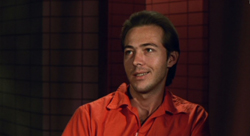 The Thin Blue Line (Errol Morris, 1988) Could have easily been a performative documentary had the filmmakers been in the re-enactments but because they were not, it is an Expository Documentary.
Don't get done, get Dom Is a great performative documentary as it exposes the subject and forces them into an interview situation without them being aware.
In conclusion, I think that interactive documentaries are a brilliant way of displaying reality whilst pushing some boundaries; Louis Theroux has got this art down to a T and can be placed in any situation and surprisingly come out alive.


Jack,
ReplyDeleteThis is a decent first draft but I am really disappointed to see that you didn't find your own examples. This shows that you haven't researched the topic and it doesn't tell me that you understand it at all. You also need to add more detail into your definitions and how the examples you find are good examples for the format.
Find your own examples to get above a merit for GC2. Also, you have not included anything on issues of access and privacy or of the contract with the viewer (if you think there is one).
I am referring this but you can get a merit with a little effort.
P.S., although rhetorician is a lovely word, you slightly overuse it.
EllieB
Jack,
ReplyDeleteWell done for finding your own examples, you have now achieved a merit for GC2 and a pass for GC1 as the detail is still very brief.
EllieB